

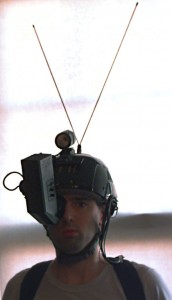
 The next chapter in the Interaction-Design.org tome on human-computer interaction design is now up for an early review to my readers. This chapter takes on Wearable Computing and is written by Steve Mann. Mostly, this is a historical review of Prof. Mann’s experimentations with wearable computing devices, and for those unfamiliar with this subject area, this is an interesting introduction.
On the left, you can see an early version of wearable computing: Steve Mann’s backpack based system from the late 1970’s and early 1980’s.
But as always, I have a slightly different take on this topic…
The Little Mac That Saved My Son’s Life
Almost 18 years ago, I went into a preterm labor. At 24 and a half weeks into gestation, this was very scary. At the time, San Francisco Children’s Hospital was pioneering a program for high risk pregnancies (which mine just turned out to be). Two doctors, Dr. Kuts and Dr. Maine, figured out how to use an old Mac SE, a modem, a telephone, a subcutaneous pump, and a belt which measures contractions to allow women like me to stay at home as much as we could (as opposed to spending months in the hospital). Here’s how this worked:
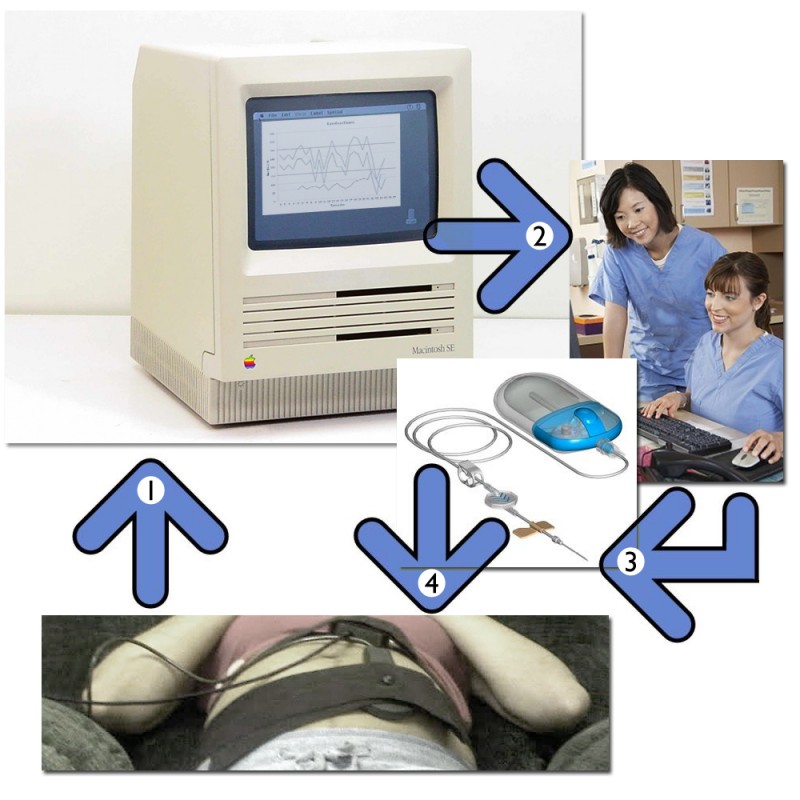
- I spent most of my time horizontally. I was wearing a wide rubber belt with a monitor that tracked my contractions through changes in pressure. I was also required to take regular pulse readings (goal was to keep me under 120 BPM — not very attainable).
- Next to me, was an old Mac SE, and my belt attached directly into the computer to deliver data into a little program that the doctor wrote. On the monitor, I could watch my contractions in real time. I could use this visual information as a feed-back system to try to relax as much as possible and see if I could keep these contractions within a satisfactory range.
- The data gathered by the program, together with my notes on my heart rate, were sent to the nurse at a monitoring station several times per day via modem.
- The nurse looked at the intensity of contractions versus my heart rate and advised on the doze strength of the Tocolytics medication administered through a subcutaneous pump in my leg. If at any time I went over the limit on contraction or heart rates, I was sent directly to the emergency room, where things got escalated to the next level.
For the most part, this system kept me home. And while I wasn’t moving much, this was a practical example of an early wearable computer system that saved two lives. There was a very good reason for this system to exist — it solved a real world problem.
SciFi — Giving Credit to Creative Futurists
I found it difficult to read a history of wearable computing and augmented reality without thinking back on all of the ideas over the last 100 years presented in science fiction novels. I’m a big fan of SciFi. And I believe in giving credit where credit is due. So here’s a little bit of credit (I only picked a few examples and there are thousands of others as wonderful and imaginative as these.).
I just finished reading Earth by David Brin, published in 1991. Lots of interesting ideas here. One (of many) that is relevant to this discussion is the notion of how society might change when everyone always wears augmented reality glasses that continuously record information (and even include enhanced, undetectable spy wear like wide spectrum recording and high-powered listening devices). David Brin, the author, describes older population using such devices to spy on youth and report crimes and personal space violations. The age divide described in the novel reverses the roles of teenagers and retirees. Teenagers choose to go “off the grid”, while retirees take on the role of social police and become abusive with wearable computing technologies. Everyone at all times is recorded. Recordings are used to prosecute violators (in this case fights, littering, and other antisocial behaviors) to the full extent of the law. Every citizen becomes a witness and evidence gathering station.


In a short story “Snow,” John Crowley explores death and the consequences of storing memories collected by Lifelogging — Prof. Mann’s term for continuous visual diary of one’s life gathered by a wearable computing device. The story was written in 1985. It’s a haunting and beautiful tale, and I won’t spoil it for you here, other than to say that this is a story of lifelogging taken to an ultimate conclusion, so to speak. This story is part of an anthology by Orson Scott Card, Future on Ice.


I’ve been reading science fiction since I was a kid, and my early readings were in Russian. I can’t remember the name of the book or the author (or much about the story, even), but one detail stayed with me all my life: every human is connected to a central computer somewhere, and every thought is monitored. The main point was to have a system that never looses a great idea, even if the person doesn’t want to share it with the world or ever speaks it out-loud. Ideas are humanity’s real treasures — everyone is precocious, everyone can be part of a solution that someday might save humanity. It was a very interesting thought. The writing was from some time in the 1970’s.
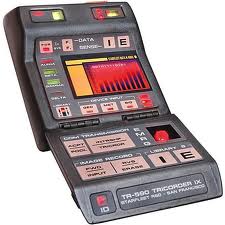 The original Star Trek TV Series premiered in 1966. Already, the central computer/ship was one of the main ideas in the story. “You’d make a splendid computer, Mr Spock.” — Captain Kirk. The hand-held devices, tricorders, that the crew carried with them to all planetary destinations gave inspiration to mobile phones, mobile health devices, and the iPad.
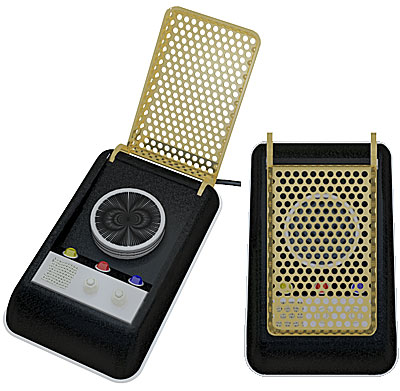
 And just to be a bit more complete, remember Get Smart? Maxwell Smart was clearly an early adapter of wearable computing:
And again, this was mid-60’s.
And so I find it difficult to read a history of wearable computers and augmented reality without acknowledging the literary inspiration for such devices. We stand on the shoulders of giants of imagination.
Compensation and Enhancement
Whenever we talk about product design, we have to talk about users of those products: Who are these people? Why would they want to use the product? What are their goals for the product? How will the users’ lives improve from interaction with the product? Where‘s the need?
I’ve written a short post a weeks ago on Compensations and Accommodations — the product design waltz. The basic idea is that with our designs we try to accommodate the widest possible audience, while we hope that the rest of the users would compensate for our product’s deficiencies and use it anyway.
Wearable computing devices are just products. Like all products, they have to answer the same basic questions: who, why, what, how, and where. In my first example — the little Mac that saved my son’s life — the wearable computing device was compensating for my limited knowledge of the state of my body and my uterus and providing feedback for better medication management.
Star Trek tricorder enhanced perceptual data gathering for Mr. Spock as he explored exotic planetary surfaces — it provided additional information and supported decision making on the ground. This is what situational awareness is all about!
David Brin’s True-Vu wearing Grempers from 2030’s Earth, used the wearable computing devices as enhancements to their senses. And in turn they served as social compensation to help control violent street crime. (Note: the book is full other wonderful examples of how computers and humans “merged”.)
Compensation and enhancement — another product design dance — enhance skills, perception, abilities; compensate for physical weakness, failing cognitive abilities, loss of perception.
Resistance is Futile

We — those of us living in the Western World — are gently sliding into a world where we are connected all the time (and not only as a social hive of Facebook): from table-top computing, to portable computers, to laptops, to mobile phones, to tablets… We crave that connectivity. And from the other side, we want devices that help sustain us: keep our hearts beating, deliver elixirs to keep us pain-free and compensate for failing body functions/chemistry, augment our memories, and free us from endless minutia of everyday living responsibilities (tell me my grocery list, pay my bills, service my car, keep my house warm, etc.).
This two-edged slide of we want and we need (enhancement and compensation) pushes us ever more into this brave new world. Someday, we won’t even realize how much of us is a computer… Resistance is futile!
So read more: Wearable Computing by Steve Mann in Interaction-Design.org
1 comment for “Special Preview: Wearable Computing (Steve Mann)”