




Welcome to Interfaces.com

This blog is dedicated to product design issues.

I hope this online collection of notes would prove valuable not only to me but to all students and colleagues looking to develop innovating and interesting products. This site focuses on product design, conceptual design, interaction design, interface design, and failure analysis.

Member Login

Lost your password?

Not a member yet? Sign Up!

RE: Deadline Pressure Distorts Our Sense of Time

November 7, 2012

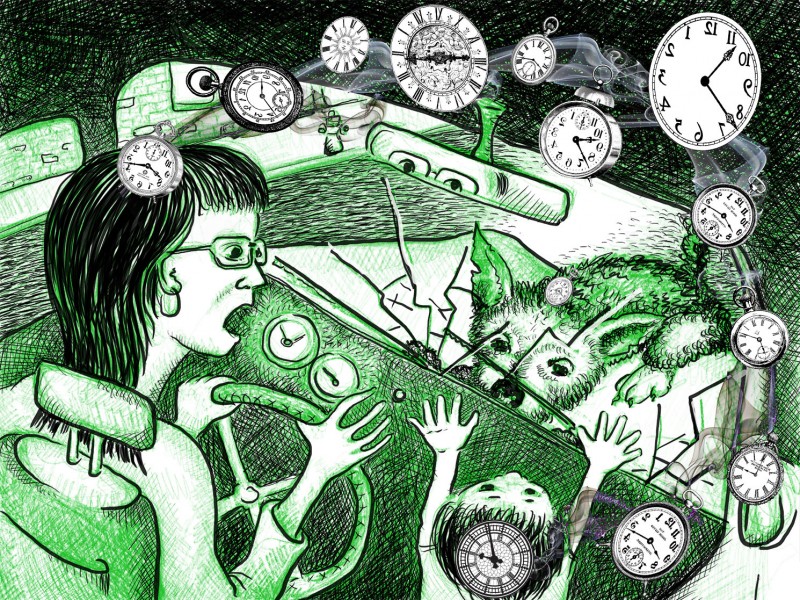
Article:  Herbert, W. (2011). “Deadline Pressure Distorts Our Sense of Time.” scientificamerican.com. Visited on October 9th, 2012: http://www.scientificamerican.com/article.cfm?id=looming-deadlines Summary:  The perceived difficulty and deadline pressure associated with a task alters our perception of time. In an initial study, subject were presented with a series of tasks of varying difficulty and asked how far away the day of completion felt to them. The tasks that were more complex and work intensive were perceived as being further in the future. To arrive at this result our brains are translating effort into time, assuming that the more difficult tasks must be further away since they will require more work to complete. An opposite effect is encountered when deadlines are associated with the tasks. If...
Read More »

Define your terms: What is sex?

November 4, 2012

The article, “Sex Makes You Smarter — Can ‘Virtual Sex’ Do The Same?” was a great example of either knowing your audience too well or over-using jargon. The most prevalent problem in it was the lack of defined terms. The author assumed that the reader knew terms like: neurogenesis, glucocorticoid levels, and dendritic architecture (a case of cognitive blindness). But the biggest failure was the author’s negligence to define the most basic term about which the article was written: sex. What is sex? Who is having it? How are they having it? These questions were unanswered. The research on which the article was based indicated that male rats were the subject of the study and were “exposed” to sexually-receptive female...
Read More »

We Are 80% Optimistic

October 31, 2012

Gallagher, James, (2011). “Brain ‘rejects negative thoughts’.”  BBC.co.uk. Visited on October 8, 2012: http://www.bbc.co.uk/news/health-15214080 This article, “Brain ‘rejects negative thoughts’”, speaks of a generalized view of the brain based on evidence gathered from a wide population. Optimists, or those whose frontal lobes process good news and comparatively ignore bad news, make up about 80% of the population; while the remaining 20%, the pessimists, have a similar predisposition to bad news. Since optimists do not absorb bad news, risks are often underestimated; as a population, it can be generalized to say that the people respond more to good news than to bad. Conceptual Design: If risks are to be acknowledged and people’s views changed to reflect them, information regarding them...
Read More »

Who Controls Social Networks?

October 30, 2012

Article: Bohannon, J. (2012). “Who Controls Social Networks?” sciencemag.org. Visited on Oct 9, 2012:http://news.sciencemag.org/sciencenow/2012/06/who-controls-social-networks.html This article is about how ideas spread in social groups through peer influence. A theory long debated is that a small number of people who are influencers spread ideas through their peer groups. Critics of the theory argue that is it not how much influence these people have but how susceptible to the new idea people are. The study of peer influence has proven difficult to conduct, but the rise of social networks such as Facebook provide a means for researchers to study a large number of people. One study in the article found that on Facebook there was a clear divide between influencers and...
Read More »

RE: Go Figure: Why we think rituals can influence results

October 30, 2012

Article: Blastland, M. (2011). “Go Figure: Why we think rituals can influence results.” bbc.co.uk. Visited on October 9th, 2012: http://www.bbc.co.uk/news/magazine-14917871 Summary: Humans have a strong capacity for pattern recognition. This is beneficial in many circumstances, aiding in our survival and helping us safely navigate our environment. However, the same cognitive mechanisms can also cause us to make incorrect associations between cause and effect. One example is a sports fan believing that a ritual like wearing “lucky” socks during an event will increase the chances of success for their favorite team. In statistics this over-interpretation of random events and correlations is known as a Type I error. The same type of behavior can be seen in animal studies, where pigeons will repeat...
Read More »

Separate Mobile Website Vs. Responsive Website

October 30, 2012
Separate Mobile Website Vs. Responsive Website

Frost, B. (2012). “Separate Mobile Website Vs. Responsive Website.” smashingmagazine.com. Visited on October 25, 2012: http://mobile.smashingmagazine.com/2012/08/22/separate-mobile-responsive-website-presidential-smackdown/ This article is about how to address the challenges of the mobile web by either creating a separate mobile website or creating a website that is responsive to different screen sizes. These two approaches are illustrated by the websites of the 2012 presidential candidates: Mitt Romney’s campaign has created a dedicated mobile website, while Barack Obama’s campaign has created a responsive website. The article looks at two use cases for these sites (someone looking for information and someone looking to take action) and how each of the different mobile approaches addresses them. Conceptual Design The article examines two mobile design approaches using Kristofer...
Read More »

RE: Perfectionism May Not Be Optimum

October 28, 2012

Tugend, A., (2011). “It’s Just Fine to Make Mistakes.” NYTimes.com. Visited on October 8, 2012: http://www.nytimes.com/2011/03/12/your-money/12shortcuts.html Experiment: A study was conducted comparing the productive abilities of participants testing high and low in “perfectionism”. The task was to rephrase a passage without interpretation for a panel of judges who were unaware of the status of the participants. The Outcome: Those rating high in perfectionism were judged to have passages “significantly poorer in quality”. This surprising finding can be attributed to a shortened process of learning in perfectionists, due to fear of failure and the loss of respect should a mistake be found. This isolation from feedback inhibits development. Additionally, the stress of perfectionism can be psychologically detrimental, further inhibiting learning especially in...
Read More »

Cultural Differences or Child Abuse

Cultural Differences or Child Abuse

We view the world through our own personal and cultural filter. We can’t help but do that. But put us in another cultural frame or time period, and we might be horrified at what we might witness. Consider this...
Read More »

Ambiguity of Natural Language and Computer Language Interpretation

Bad Cop Good Cop Language Abmiguity

In his book “The Stuff of Thought: Language as a Window into Human Nature”, Steven Pinker gave the following defense of language ambiguity: Imagine you are stopped by a traffic cop for a violation. You would rather not get...
Read More »

Press Release: World’s Tech Elite Named to Interaction-Design.org Board

Press Release: World’s Tech Elite Named to Interaction-Design.org Board

Today the Interaction Design Foundation, the IDF, has announced its new executive board. The executive board includes Don Norman; Bill Buxton, Principal Researcher at Microsoft Research; Ken Friedman, professor and former dean of the Faculty of Design at Swinburne...
Read More »

Task Analysis and Product Design

Task Analysis and Product Design

Imagine your were given an assignment to develop a product that could help people eat healthy. How would you go about creating such a thing? What would you need to learn/understand? What is the right medium or technology vehicle...
Read More »

Going Potty…or iPotty!

Going Potty…or iPotty!

An iPotty App for kids learning to use a toilet: And here’s a bit for an older audience: Would it have worked if the sexes were reveres — images of staring men on the walls of women’s room? I...
Read More »

Musings on Failure in School

Musings on Failure in School

The Math Obstacle In the past few years, reports came out showing strong correlation between failing Algebra and graduation rates — if a kid fails math, he/she won’t be getting their high school diplomas. Here are a few articles...
Read More »

25 Awesome Quotes, 11 Ways, 10 Hateful Things, 8 Steps, 7 Reflections, 5 Hard Facts, 3 Reasons Why, 2 Questions, and 1 Mistake

5 second test

The latest in the professional social media writing is the creation of lists. Sing it with me: 25 Awesome Quotes 11 Secrets & 11 Ways 10 Hateful Things 8 Steps 7 Reflections 5 Seconds Test & 5 Hard Facts...
Read More »

Kurisumasu ni wa kentakkii!

Kurisumasu ni wa kentakkii!

Who would have thought that our KFC fried chicken would be an object of desire in Japan? But perhaps all it takes is some very good PR (and some luck), and a product designed to please a very specific...
Read More »


UCLA Law Forum: Discuss International Criminal Law

UCLA Human Rights and International Criminal Law Forum Logo

UCLA School of Law and International Criminal Court's Office of the Prosecutor partnered together to create UCLA Law Forum—a place to discuss international law issues. My company, Pipsqueak Productions, designed and developed the site. Please join the debate! UCLALawForum.com.

.


Tim and Nick Werby with DRIPS Prototypes

DRIPS project — stands for Deep Root Irrigation and Precipitation System — is a simple device that collects atmospheric water and delivers it to the roots of plants below the evaporation layer. My sons, Tim and Nick Werby, designed and developed the idea and the site. DRIPSproject.

.


Cost of Chicken Project is a crowdmapping project that tracks the true costs of food around the world. Most data points are contributed by kids. My sons, Tim and Nick Werby, designed and developed the idea and the site. Please visit their site and contribute the data points from your area. Cost of Chicken.