Welcome to Interfaces.com

This blog is dedicated to product design issues.

I hope this online collection of notes would prove valuable not only to me but to all students and colleagues looking to develop innovating and interesting products. This site focuses on product design, conceptual design, interaction design, interface design, and failure analysis.

Member Login

Lost your password?

Not a member yet? Sign Up!

Design Solution to Real World Problem — Speeding!

April 25, 2012
By

Knowing something about behavior, visual processing, and human nature, designers can nudge users into doing the right (or in this case, lawful) action. Speeding is a problem all over the world. People are notorious for underestimating the real amount of time it takes to get places they need to be. Traffic congestion, car problems, detours, and other (un)foreseen events can make a huge difference in time variability of getting from one place to another. The problem, though, is that we can’t really force people to leave on time or drive the speed limit when the drivers think that no one is looking. So with the law on our side, we can create other ways of forcing people to behave lawfully by changing environmental conditions and relying on human nature not to do what’s right, but to do what they think they have to based on circumstance.

Here are a few creative ways of solving the speeding problem on our streets.


Using Visual Processing Errors to Slow Traffic
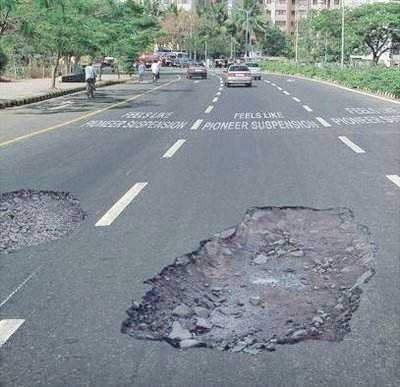
Canada Road Slowdown Project

Canada Road Slowdown Project

Canada Road Slowdown Project

Canadian drives misdiagnose the problem and try to drive straddling the “hole” in the road. Everyone is successfully slowed down.


The Fake Traffic Cop Threat as a Speeding Deterrent

In general, people tend to do the right thing IF someone is watching. A few blogs ago, I wrote about a hospital administrator who came up with a brilliant idea of putting signs in the hospital bathrooms that said: “Check to see if the people in the bathroom are washing hands prior to leaving.” If the sign simply advised the employees to wash hands, it wouldn’t have worked nearly as well (the rate of hand washing for doctors and nurses almost doubled!).
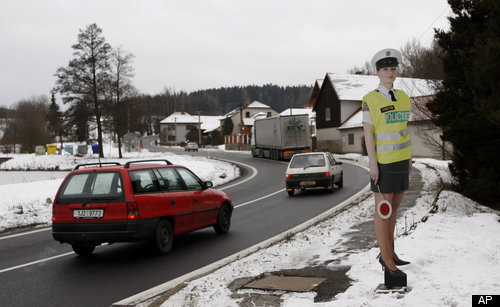
Fake Police Woman in a miniskirt

In the example above, to make sure that drivers really slow down (as if snowy conditions are not enough), this Czech village combined a watchful police with an added draw of exposed legs. Sex and the law — a winning combination to slow drivers.

Here in U.S., we don’t need the legs — just a radar gun would do:
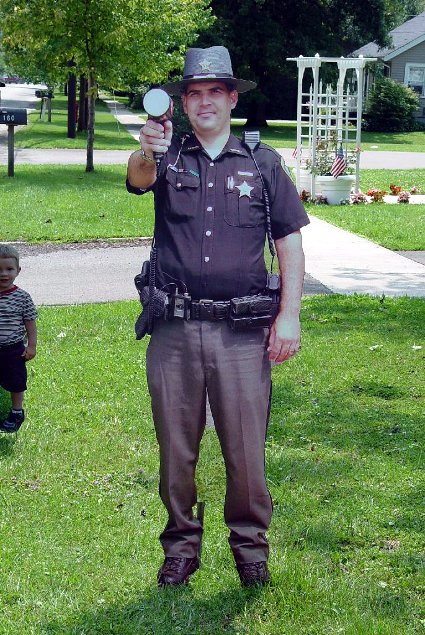
Fake Deputy

Or a cut out of a cop car:

Cop Car Cut Out

I’ve read about old broken cars left on the side of the road as cautionary reminders to drive safely. Fake blood and mannequins can add to the effect…

The main idea is to use visual “threats” to nudge drivers into lawful behaviors.

Tags: , , , , , , , , , ,

Leave a Reply

Pipsqueak Articles

Ambiguity of Natural Language and Computer Language Interpretation

Bad Cop Good Cop Language Abmiguity

In his book “The Stuff of Thought: Language as a Window into Human Nature”, Steven Pinker gave the following defense of language ambiguity: Imagine...
Read More »

Press Release: World’s Tech Elite Named to Interaction-Design.org Board

Press Release: World’s Tech Elite Named to Interaction-Design.org Board

Today the Interaction Design Foundation, the IDF, has announced its new executive board. The executive board includes Don Norman; Bill Buxton, Principal Researcher at...
Read More »

Task Analysis and Product Design

Task Analysis and Product Design

Imagine your were given an assignment to develop a product that could help people eat healthy. How would you go about creating such a...
Read More »

Going Potty…or iPotty!

Going Potty…or iPotty!

An iPotty App for kids learning to use a toilet: And here’s a bit for an older audience: Would it have worked if the...
Read More »

Musings on Failure in School

Musings on Failure in School

The Math Obstacle In the past few years, reports came out showing strong correlation between failing Algebra and graduation rates — if a kid...
Read More »

25 Awesome Quotes, 11 Ways, 10 Hateful Things, 8 Steps, 7 Reflections, 5 Hard Facts, 3 Reasons Why, 2 Questions, and 1 Mistake

5 second test

The latest in the professional social media writing is the creation of lists. Sing it with me: 25 Awesome Quotes 11 Secrets & 11...
Read More »

Kurisumasu ni wa kentakkii!

Kurisumasu ni wa kentakkii!

Who would have thought that our KFC fried chicken would be an object of desire in Japan? But perhaps all it takes is some...
Read More »

Google Apps New Pay Policy and Behavioral Economics

Google Apps New Pay Policy and Behavioral Economics

Yesterday, Google flipped a switched on its Google Apps policy — starting with December 7th, 2012, Google Apps will no longer be free! The...
Read More »


UCLA Law Forum: Discuss International Criminal Law

UCLA Human Rights and International Criminal Law Forum Logo

UCLA School of Law and International Criminal Court's Office of the Prosecutor partnered together to create UCLA Law Forum—a place to discuss international law issues. My company, Pipsqueak Productions, designed and developed the site. Please join the debate! UCLALawForum.com.

.


Tim and Nick Werby with DRIPS Prototypes

DRIPS project — stands for Deep Root Irrigation and Precipitation System — is a simple device that collects atmospheric water and delivers it to the roots of plants below the evaporation layer. My sons, Tim and Nick Werby, designed and developed the idea and the site. DRIPSproject.

.


Cost of Chicken Project is a crowdmapping project that tracks the true costs of food around the world. Most data points are contributed by kids. My sons, Tim and Nick Werby, designed and developed the idea and the site. Please visit their site and contribute the data points from your area. Cost of Chicken.