
Welcome to Interfaces.com

This blog is dedicated to product design issues.

I hope this online collection of notes would prove valuable not only to me but to all students and colleagues looking to develop innovating and interesting products. This site focuses on product design, conceptual design, interaction design, interface design, and failure analysis.

Member Login

Lost your password?

Not a member yet? Sign Up!

Special Preview: Activity Theory

March 13, 2012
By

Once again, we get an early preview of the next chapter of Interaction-Design.org textbook: Activity Theory. The author of the chapter, Victor Kaptelinin, did a wonderful job of summarizing decades of research in educational psychology, cognitive science, and HCI — from Vygotsky to Moran. If you’re unfamiliar with the theories, research, and thinking that brought us to present day HCI design, this is a great place to start (and includes all of the references to the relevant literature).

Adopting an activity-theoretical perspective has an immediate implication for design: it suggests that the primary concern of designers of interactive systems should be supporting meaningful human activities in everyday contexts, rather than striving for logical consistency and technological sophistication.

While this chapter focuses mainly on human computer interaction (HCI), I would argue that we need to be broader: we need to focus on product design. And as always, I mean product to be interpreted in a very broad sense.

We are moving rapidly into a world where everything we touch is a computing device. Today, I Twitted that my washing machine is an ICT device — the new ARM chip is small, requires very little power, and will be incorporated into everything. So as designers, we have to think not in terms of devices, but in terms of goals and motivations: Why is this person using this device? What do they hope to accomplish? How can we support their problem solving? This is nothing new to my students…

But as an illustration let me talk about a chisel and a log. If you have these and given enough time, you might make a dugout canoe. But if you had access to a boat factory, skilled workers, and cutting edge materials, your maritime options might be much broader. But this breadth of possibilities comes with a price: we need to know more to be able to use these tools in a productive and creative ways. So the new world of product designers is much more complicated and much more interesting. How do we go about supporting people working together to accomplish goals that we haven’t even thought of for our products? How do we motivate people to work together? To be more productive? To be more creative? To think outside of the box? To spend the time to learn how to use our products? It’s an interesting challenge. And the Activity Theory provides some of the foundational support into thinking about product design.

Goals, Expertise, and Situations

In our product design classes, we talk about everything being situational: Need to change a lightbulb? That chair looks like a stepping stool. We go about our lives solving problems, from little ones to major ones, from lightbulb malfunction to new cancer therapy. As designers we want to support those efforts and we do that with scaffoldings: cognitive (just-in-time help), psychological (permission giving), physical (strong chair legs), etc. What users need depends on what, where, and when of their problem solving instance.

A few months ago, I wrote about crisis mapping and the movement of information between the people in crisis, individuals providing direct help on the ground, information gatherers, and the media. There were feedback data loops and it was particularly important to understand the goals, expertise, and the situation of each group as they acted out their respective roles in the crisis. Below is diagram of this information flow and here’s a link to the blog post. It’s easy to see Activity Theory in action!
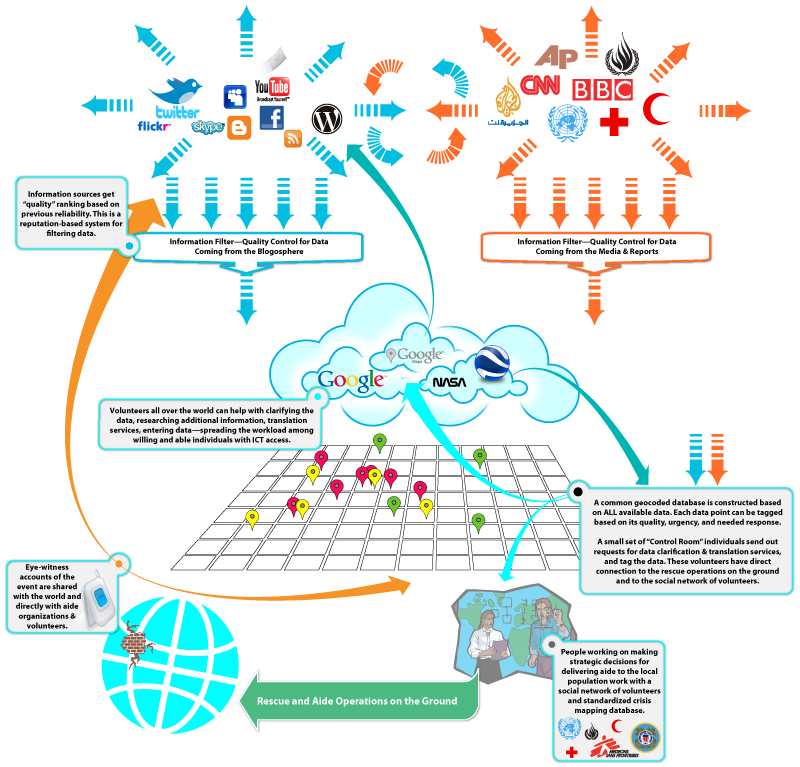
Crisis Mapping Illustration

Tags: , , , , , , , ,

Leave a Reply

Pipsqueak Articles

Cultural Differences or Child Abuse

Cultural Differences or Child Abuse

We view the world through our own personal and cultural filter. We can’t help but do that. But put us in another cultural frame...
Read More »

Ambiguity of Natural Language and Computer Language Interpretation

Bad Cop Good Cop Language Abmiguity

In his book “The Stuff of Thought: Language as a Window into Human Nature”, Steven Pinker gave the following defense of language ambiguity: Imagine...
Read More »

Press Release: World’s Tech Elite Named to Interaction-Design.org Board

Press Release: World’s Tech Elite Named to Interaction-Design.org Board

Today the Interaction Design Foundation, the IDF, has announced its new executive board. The executive board includes Don Norman; Bill Buxton, Principal Researcher at...
Read More »

Task Analysis and Product Design

Task Analysis and Product Design

Imagine your were given an assignment to develop a product that could help people eat healthy. How would you go about creating such a...
Read More »

Going Potty…or iPotty!

Going Potty…or iPotty!

An iPotty App for kids learning to use a toilet: And here’s a bit for an older audience: Would it have worked if the...
Read More »

Musings on Failure in School

Musings on Failure in School

The Math Obstacle In the past few years, reports came out showing strong correlation between failing Algebra and graduation rates — if a kid...
Read More »

25 Awesome Quotes, 11 Ways, 10 Hateful Things, 8 Steps, 7 Reflections, 5 Hard Facts, 3 Reasons Why, 2 Questions, and 1 Mistake

5 second test

The latest in the professional social media writing is the creation of lists. Sing it with me: 25 Awesome Quotes 11 Secrets & 11...
Read More »

Kurisumasu ni wa kentakkii!

Kurisumasu ni wa kentakkii!

Who would have thought that our KFC fried chicken would be an object of desire in Japan? But perhaps all it takes is some...
Read More »


UCLA Law Forum: Discuss International Criminal Law

UCLA Human Rights and International Criminal Law Forum Logo

UCLA School of Law and International Criminal Court's Office of the Prosecutor partnered together to create UCLA Law Forum—a place to discuss international law issues. My company, Pipsqueak Productions, designed and developed the site. Please join the debate! UCLALawForum.com.

.


Tim and Nick Werby with DRIPS Prototypes

DRIPS project — stands for Deep Root Irrigation and Precipitation System — is a simple device that collects atmospheric water and delivers it to the roots of plants below the evaporation layer. My sons, Tim and Nick Werby, designed and developed the idea and the site. DRIPSproject.

.


Cost of Chicken Project is a crowdmapping project that tracks the true costs of food around the world. Most data points are contributed by kids. My sons, Tim and Nick Werby, designed and developed the idea and the site. Please visit their site and contribute the data points from your area. Cost of Chicken.