Welcome to Interfaces.com

This blog is dedicated to product design issues.

I hope this online collection of notes would prove valuable not only to me but to all students and colleagues looking to develop innovating and interesting products. This site focuses on product design, conceptual design, interaction design, interface design, and failure analysis.

Member Login

Lost your password?

Not a member yet? Sign Up!

The Trouble with Social Search

January 16, 2012
By

Truth in Search Independent of the Seeker

There have been changes in Google search and Google analytics. There have been many discussions on this topics. But there’s one big problem that I see with adding the social dimension to search: community bias or, as we’ve been referring to it in class, cultural bias. Cultural bias is one of the sources of human errors that render problem solving more difficult. The problem comes from having one’s views on highly charged emotional topics (or social issues) continuously reinforced by the community. I’m writing this blog on Martin Luther King Day — particularly appropriate when discussing cultural bias and the difficulties of overcoming them.

In the past, when we googled something, we got results based on the relevance to our query. This relevance had little to do with us personally and focused on the topic of interest. Google results to a politically polarized question looked the same whether one was a democrat or a republican:

Cultural Mix of Search Results

It didn’t matter that democrats tended to socialize with like-minded individuals — meaning other democrats. And republicans preferred other republicans, creating segregated social circles. In each such circle, people met, talked, and reinforced each other’s beliefs. BUT the Google results were the SAME for each group, regardless of what politics or religion they practiced.

Segregated Circles Social Circles

All this is changed with the introduction of Google + data into the search results.
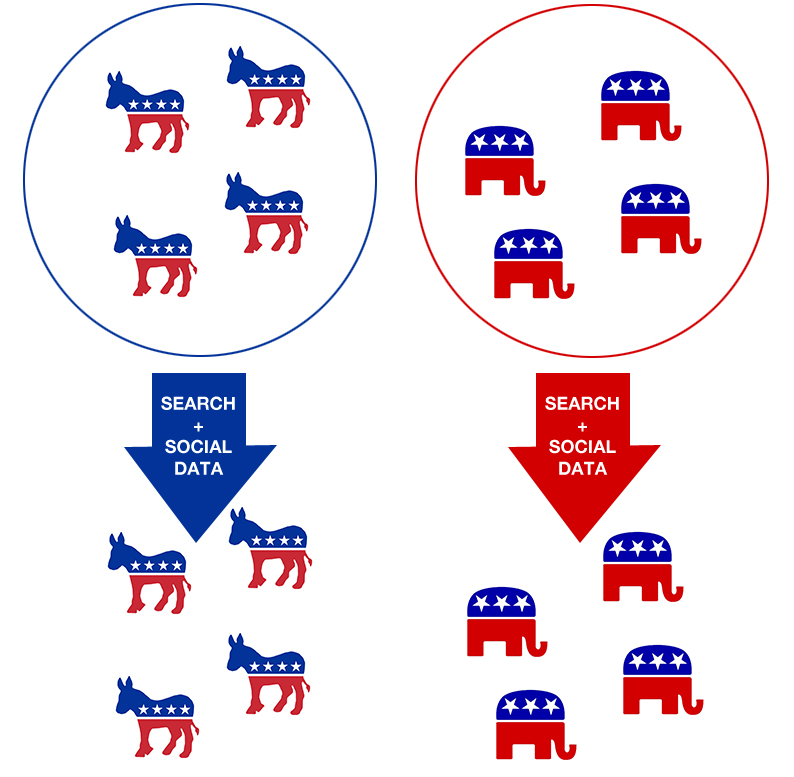
Search with Social Data added to the search variables

Now the search results will be different depending on who your friends are! The results are no longer unbiased, but heavily favored towards what you already believe in and who your friends are and what they believe in.

While some might find this reassuring — it’s great when the world agrees with you — I’m extremely concerned. I want the truth, irrespective of what I personally believe in or want to believe in. Truth independent of the observer.

Tags: , , , , , , , , ,

Leave a Reply

Pipsqueak Articles

Creativity, Perception, and Public Art

Coming Unzipped

Art or craft? Creativity or public nuisance? Sometimes, the line between these is so fine, so complex, so fractal, that it’s simply doesn’t matter....
Read More »

Designing for the Blind

Not much to add here — how many other cool video games are there for visually disabled? Using tactile clues instead of visual signals...
Read More »

Special Preview: Philosophy of Interaction and User Experience

A person uses a piece of software, a Web site, or any other product — “virtual” or “real” — to achieve a goal. The...
Read More »

End-User Development (EUD) Educational Preview

This is an interesting collection of videos and background materials on End-User Development — situations when end users design and develop software for their...
Read More »

Thinking about the Science of Communication and Interaction

Alien Senses

In the Galaxy Far Far Away… What if sentient being evolved on a planet with permanent cloud cover? What if these being never saw...
Read More »

Using Positive Emotion to Change Behavior

Games can be used to change our behavior — make something fun, and we are likely to do it again and again. Psychologists call...
Read More »

Special Preview: Social Media by Thomas Erickson

Interfaces.com was given a free advanced preview of Thomas Erickson’s report and videos on social computing. The videos are very well produced and provide...
Read More »

Design Variables